Begin with what a surface does
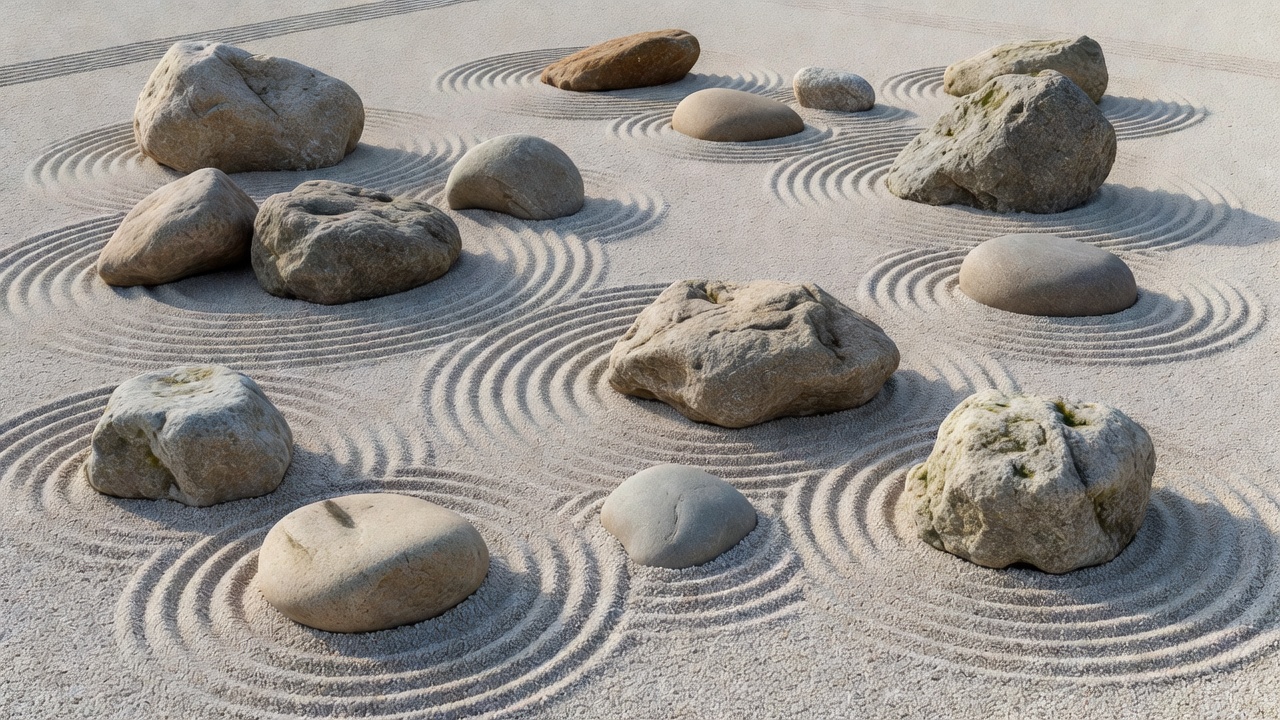
A dry-landscape garden, commonly described with the term karesansui, can suggest a wider landscape without using a pond or stream. Yet the absence of open water does not make its materials abstract. Gravel reflects light. Stone holds shadow. A low patch of moss makes a different edge from a straight wall. These differences shape attention even when a visitor knows nothing about a garden’s history.
Try making a short description without symbolic nouns. Instead of “an island in a sea,” write “a dark, low stone surrounded by pale, evenly worked ground.” The second description does not cancel the first. It simply records evidence that another viewer could check. Interpretation becomes more useful when its starting point is visible.
Stone has direction as well as mass
A stone can appear to lean, settle, rise or turn. Its grain and weathering may strengthen that impression. The portion below ground also matters: what looks like a stable, effortless placement may depend on deliberate burial and supporting work. A photograph rarely tells us how much of a stone is hidden, so claims about its original placement need more than an attractive angle.
Groups change individual stones. A small, low piece may make a taller one appear more upright; a broad interval can separate two masses that would otherwise read as one. Count if counting helps, but do not assume a particular number supplies a universal religious message. Some arrangements have documented associations. Others have accumulated later explanations that deserve to be identified as such.
Gravel is worked ground
Pale gravel is often described as a sea, and raked lines may encourage that reading. In another context, the surface may be discussed through light, texture, ceremonial order or the practical history of a courtyard. The safest formulation is specific: this pattern resembles flowing water to a viewer, or this temple’s interpretation identifies it with water. Neither statement licenses a rule for every garden.
Notice the scale of the aggregate and the depth of the lines. Fine and coarse materials catch light differently. Straight runs, curves and rings lead the eye in different ways. A pattern is also temporary: weather, leaves and maintenance affect it. The garden you encounter is not a sealed image surviving untouched from its first construction.
Moss is living material, not effortless atmosphere
Moss can soften a boundary, hold moisture and make the foot of a stone visually distinct from the gravel around it. Its appearance depends on species, weather, shade, substrate and care. Not every green surface is the same plant community, and a distant photograph cannot reliably identify it. Even a seemingly spontaneous patch exists within a managed environment.
Saihō-ji in Kyoto is well known for its moss, but its living surfaces should not be turned into a claim that all Japanese gardens are moss gardens. Nor should their appearance become a simple home-care recipe. A sunny, dry courtyard elsewhere may require entirely different planting. Attentive design begins with local conditions rather than copying a photograph’s color.
The interval is part of the material vocabulary
Open ground is not merely what remains after stones have been installed. Its width, brightness and continuity make groupings legible. A narrow gap may hold attention more strongly than a large object. The wall, veranda and surrounding vegetation help determine whether that gap feels compressed or expansive. Looking at the interval can therefore change how you understand the objects on either side.
The Japanese term ma is sometimes used in discussions of spatial interval. It can be a helpful prompt, but it is not a shortcut to an authentic reading of every garden. Begin with the particular relationship: how far apart are the elements, from which viewpoint, and under what light? A broad cultural word should sharpen those questions rather than replace them.
A five-minute material reading
Choose one visible group from a permitted viewing place. Spend the first minute describing its outline, the second comparing its surfaces and the third following the edge where it meets the ground. Use the fourth minute to study the space around it. Only then consult a guide or label. Your initial account may change; that is a reason to keep looking, not a sign that the exercise failed.
Never enter a gravel area, collect a stone or touch moss to test an observation. A visitor’s close attention can remain entirely visual. The garden’s material life includes its vulnerability to feet, hands and repeated disturbance.
Reading notes and sources
- Marc Peter Keane, Japanese Garden Design (1996): an introduction to forms, materials and design relationships.
- David A. Slawson, Secret Teachings in the Art of Japanese Gardens (1987): a study of design principles and their transmission.
- Saihō-ji official visitor information: consult the temple directly for access and its account of the site.
- For historical cautions about symbolism, continue with the histories guide.